


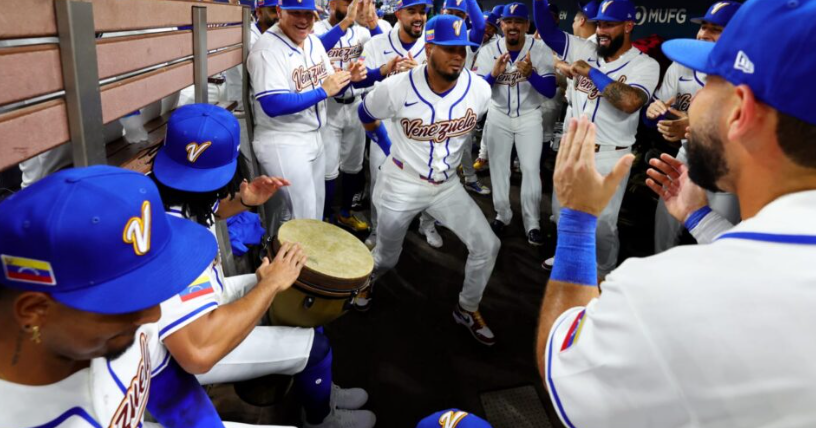
That energizing sound the world heard during the World Baseball Classic carries centuries of history, from slavery to urbanization and mass migration
Publicado en: Caracas Chronicles
Por: Rafael Osío Cabrices
“¡Ay! Julián, Julián, Julián José
Repícame los tambores
que me los quiero aprender“
One of the many wonderful things that Venezuela’s victory in the 2026 World Baseball Classic brought us, is a glimpse into one of the most appealing features of this country’s folk culture: los tambores de la costa, the drums of the coast. Sports media and social media influencers have spread videos of fans and players beating drums and dancing to a frenzy, primal beat where women seem to lose their lumbar vertebrae. It’s sexual and elegant at the same time. It looks very intimate when a couple is at it, but that connection is ephemeral because soon one of them is replaced by another person, in a fluid competition inside a circle full of people dancing, clapping and screaming.
I grew up in the central region of the country, in Caracas and Valencia. For me, tambores have always been there, just like Venezuelan calypso is for people in Guayana, joropo for llaneros and gaitas in Maracaibo. It’s funny to explain in English how to dance to them, because most of us know how to do it since forever. It’s part of us and our landscape, like arepas and baseball.
Today they are part of the national musical canon, but the genre and the cultural phenomenon we collectively call tambores were developed in specific regions and Afro-Venezuelan communities. Their history is long and fascinating.
The first journey: slavery and freedom
Slavery in Venezuela started early in the 16th century, when the conquistadors saw that indigenous labour—depleted by conquest wars and disease of European origin—wouldn’t help much with their goal of exploiting the land. Men and women were captured by African or European traffickers in West Africa, shipped to what is now the Dominican Republic, and sold to Spanish conquistadors first, and later to rich criollos, the land owners and settlers of Spanish ascendancy, like the family of Simón Bolivar. Those slaves, the bottom layer of a society divided by race, had fewer rights than indigenous people and were forced to work mostly in cocoa and sugar cane plantations in the fertile valleys of north-central Venezuela.
During the following centuries, some slaves managed to escape and created communities, called cumbes, far off colonial militias in the thick jungles between the sea and the mountains that encircled cities like Caracas and Valencia. The Independence wars from 1810 to 1823, and the end of slavery in 1854, populated the coastal towns with free Venezuelans of African origin. By that time, they were all converted to Catholicism, but Yoruba religion, words from the languages of the Gulf of Guinea, and customs like drum music had survived in altered forms since the capture of their ancestors in Africa. At night, around a fire, they told stories through the music of their tambores.
Those traditional instruments are made by cutting certain trees, burning and carving the trunks to create resonance chambers, and covering them with goat hide and rope. From the jungle of Barlovento, east of Caracas, all along the green, meandering coast to what is now Yaracuy and Carabobo states, many villages developed a battery of different drums, like cumaco and culo e puya, as well as minor percussion instruments like quitiplas. Men built and played the drums, showing off their strength and stamina; women chanted and danced to channel the goddesses of their myths. Like in some traditional African genres, a choir repeats a phrase that is answered by variations from a lead singer, man or woman. The effect of repetition and rhythm can send you into a trance. Especially if you are barefoot on a beach, with a bonfire breaking the night, and a bottle of rum making the rounds.
Those are what are currently known as tambores de la costa, from the Barlovento-Carabobo coastline. Other regions in Venezuela developed other genres of traditional Afro-Venezuelan music. Former slaves in the basin of Lake Maracaibo created the San Benito dances in villages like Bobure. In Guayana, people of African heritage who spoke English arrived from the Antilles to search for gold and became Venezuelan, creating Venezuelan calypso, which is musically different and sung in English and Spanish. African influence is present in other specific genres in Lara, Yaracuy and the famous gaitas from Zulia. Venezuela’s traditional culture is as complex and diverse as the country’s territory and population.
Tambores were not used in war, as many other traditional instruments: they were the objects of cultural resistance, a way to keep alive the African heritage that the horrors of human trafficking and forced acculturation were trying to extinguish in the ultra-Catholic colonial regime, which demonized the language, the religion and the music of the slaves. Eventually, the Church and the local leaders of the Republic allowed tambores to be played during festivities like the diabladas. They ceased to be forbidden music and were gradually woven into the cultural fabric of the nation-state, especially when the 20th century came and tambores made another journey, changing their role in Venezuelan society.
The second journey: from the beaches to the metropolis
Venezuela was deeply transformed since the 1940s, when oil income made big cities like Caracas irresistible magnets for domestic migration. Then, former cocoa farmers from Barlovento or fishermen from Choroni moved to work in Caracas, Valencia, Maracay, carrying their tambores with them. Entire villages were transplanted to barrios in the outskirts of the cities, and after work, or during the San Juan feast in the summer solstice, the drums and the chants echoed up to the sky. In 1948, the government organized an unprecedented festival to display the traditions of Venezuela’s many regions, and people from the rest of the country were able to see and hear tambores.
After the Perez Jimenez dictatorship in the 1950s favored joropo as the quintessential Venezuelan folk and ballroom Big Bands like Billo’s Caracas Boys, tambores came back with democracy. A more connected country allowed tambores to enter media, universities, and urban public space. In the 1980s, laws that promoted the broadcasting of Venezuelan music on the radio, as well as the development of the recording industry, made possible the surge of bands focused on Afro-Venezuelan music, like Grupo Madera and Un Solo Pueblo. Tambores were no longer isolated in the beach towns of the central coast.
Diosdado Cabello: “Our people must be prepared and alert, in every instance, on every front, in every way and form.”
I don’t know how many times I attended concerts of bands like Un Solo Pueblo. It was common to see them play at corporate parties or city festivals. Tambores took over the stadiums during baseball games, and the custom spread to other sports. When I went to ultimate frisbee matches in Valencia in the 1990s, the rival team from Maracay had the advantage that their fans had tambores from Choroní with them.
The genre was absorbed by salsa and jazz musicians, and popular bands like Tambor Urbano became a staple in fancy parties, where they marked the climax of the night by storming the place with their drums, their singers and the guaruras: the giant snail shells that the Caribe tribes used to instill fear among their enemies.
This playlist on Spotify can show you the range of tambores in Venezuela, starting with traditional drum music from Ghana (the only non-Venezuelan track in the list, just to compare) and the traditional tambores de la costa, to the cousins in Guayana’s calipso, Yaracuy’s sangueo and Zulia’s gaita, and finally the explorations with jazz fusion:
The third journey: the sound we carry with us
Tambores have traveled with the Venezuelan migrants. You can’t move with a battery of culo e puyas, but you can find a couple of good drums everywhere and adapt them to the beat if you’ve learned how to play them from a master or by attending workshops at Fundacion Bigott. Only the cuatro or the maracas are more portable. The harp of musica llanera is big and heavy, and more difficult to play.
Tambores are having a moment. Just before the Venezuelan team reached the semis in the World Baseball Classic, Vogue made an exquisite special in Chichiriviche de la Costa with a women-only tambores band and the choreographer Eileyn “Negra” Ugueto.
More resonant is the role they played in the epic baseball championship in Miami, the world’s most influential city for Latino culture. Some of the baseball team members come from those beach towns where tambores have been resounding for centuries: Ronald Acuña Jr, for example, comes from La Sabana, a village on the coast close to Caracas where tambores are a staple. Other big leaguers like Kelvin Escobar come from that village as well. It’s only natural that they transplanted to the US the custom of playing tambores in the baseball stadiums.
US-based Venezuelan artists trained in traditional genres, like the members of C4 Trio, Miguel Viso or Mafer Bandola, are already spreading the possibilities of cuatro and bandola, our most representative string instruments. Now, tambores will follow them to concert halls. This is why the championship of the World Baseball Classic is more than the sport feast that allowed all Venezuelans, in the country and abroad, to celebrate an achievement that is pure good news, pride and joy. But the world already knew Venezuela is outstanding at baseball. Now, it can also discover the tambores de la costa that we have been letting possess our bodies for centuries, and surrender to their spell.