

The Venezuelan politician hoped to become her country’s leader with help from the U.S. The Trump Administration had other priorities.
Published in: The New Yorker
When Venezuela was struck by a series of catastrophic earthquakes this June, the exiled opposition leader María Corina Machado decided that she needed to return home. She had spent nearly six months in Washington, carrying on a frustrating fight over her country’s political future—and her own. But the earthquakes created a crisis too great to ignore. City streets cracked, and buildings were reduced to rubble. Hospitals were overwhelmed. It was estimated that more than a hundred thousand Venezuelans could die.
Machado was accustomed to managing difficult conditions. She had made a career in Venezuela as a woman in a macho political culture, and as a wealthy conservative in a place where socialism was the national ideology. She built a following by accusing President Nicolás Maduro of waging a long-running war on his own people, including thousands of arbitrary arrests and killings. In 2024, she led her party to victory in the Presidential election, winning two-thirds of the vote. Rather than cede power, Maduro sent his security forces to attack protesters and round up opponents.
After the U.S. military surged into Caracas and arrested Maduro, on January 3rd, many Venezuelans expected Machado to be the country’s new leader. She had worked insistently to secure recognition from the United States and other allies abroad. Just three months before, she had been awarded the Nobel Peace Prize for her “tireless work promoting democratic rights for the people of Venezuela.” But, when Donald Trump announced the operation, he did not refer to Machado, or even mention the word “democracy.” Instead, he talked about Venezuela’s huge petroleum reserves. “We’re going to get the oil flowing the way it should be,” he said. In the interest of stability, Maduro’s Vice-President, Delcy Rodríguez, would be left in charge.
Observers around the world accused Trump of heedlessly toppling a foreign government, with no plan for the future. Machado, though, was careful not to issue a single criticism. Instead, she commended Trump’s “courage and vision” and took every opportunity to thank him. After arriving in Washington, this January, she handed Trump her Nobel. In exile, Machado kept working toward a vision of Venezuela that seemed increasingly elusive: a free country, with her as President. The Trump Administration has laid out a three-phase plan, entailing stabilization, recovery, and, ultimately, a political transition. But the Venezuelan government has not yet put forth a timeline for elections, much less shown a willingness to surrender power.
After the earthquakes, however, the regime seemed newly vulnerable. Despite its efforts to suppress the media, images of the destruction spread online, along with anguished calls for help. Rescue workers from around the world rushed to Venezuela but found that equipment was outdated and scarce. Fuel was in short supply, and cranes stood idle beside flattened buildings.
With the regime so ill-prepared, the Venezuelan people were left to gather whatever tools they could to dig their relatives and neighbors from the rubble. From D.C., Machado mobilized teams to set up aid centers. If a hospital needed a computer to read CT scans, or a rescuer was held up at the border, her people would assist. Still, Machado’s phone filled up with desperate calls. “I know that you will help us,” one elderly woman said.
The morning after the earthquakes, Machado told Secretary of State Marco Rubio that she had resolved to go back. She insisted that it was in everyone’s interest—including the United States’. Though there was no guarantee that the regime wouldn’t arrest her, U.S. officials acknowledged that she had a right to return.
Early the next day, Machado went to the Manassas Regional Airport, in Virginia, and boarded a small jet with a few aides. She planned to fly to the island of Curaçao, then proceed to Venezuela. About an hour into the flight, though, a message came through: the plane was not authorized to land in Curaçao. Machado dismissed the message, convinced that it was a misunderstanding. Then, a few minutes later, the pilot got a direct order. The plane’s landing rights had been revoked, apparently under political pressure. They had to return to Manassas at once.
For Machado, it was another setback in a long campaign. She remains the most popular politician in Venezuela, but she can’t lead unless she goes back. The Trump Administration, which substantially controls the Venezuelan state, seems convinced that her return would deepen the country’s tumult—destabilizing both the regime and the United States’ aims there. “Politics is a contact sport,” James Story, the former American Ambassador to Venezuela, told me. “The regime sees Machado as an existential threat. Her return raises the question: Who’s in charge?”
Machado’s office in Washington sits not far from the White House, in a nondescript building off Connecticut Avenue. When I visited, soon after she arrived in D.C., the office had a transient air. The space belonged to a lobbying group for maritime workers: paintings of sailing ships hung above Chippendale-style furniture. Aside from some placards with slogans for her party, there was no indication of who the new occupant was. “It’s our shadow embassy,” David Smolansky, one of her advisers, told me, with a thin smile. The office was staffed with longtime Machado aides, who had left families behind in Venezuela. Most had fled the country after the 2024 election, but there were some she hadn’t seen in nearly a decade. Smolansky had escaped across the Brazilian border in 2017, dressed as a priest and carrying a Bible.
From the office, Machado shuttled to meetings with foreign ministers, Trump’s Cabinet officials, Congress members on both sides of the aisle, and various benefactors. During my visit, she walked down the hallway with Crown Prince Reza Pahlavi, the son of the Shah of Iran. Trump hadn’t yet declared war on Iran, but the country was roiling with protests, which had been harshly suppressed. Pahlavi and Machado posed for pictures and agreed to issue a joint statement, endorsing the “liberation of Iran and Venezuela from oppression.”
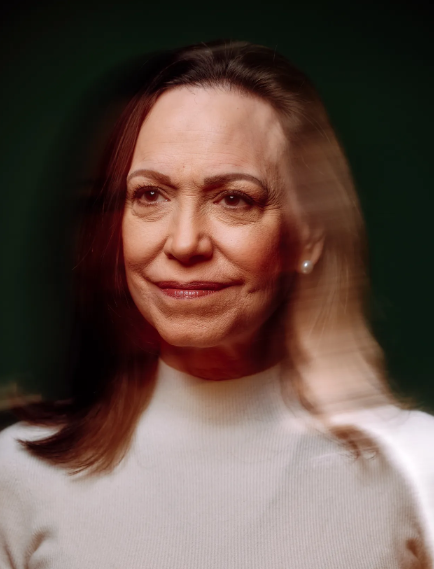
Machado, fifty-eight, wore a red cashmere sweater and black pants; her brown hair hung to her shoulders. In person, as onstage, she tends to talk in absolutes. “I have a mandate from the Venezuelan people to free this country together,” she told me. “We will accept nothing less than full democracy.” Critics had described Trump’s invasion as a violation of Venezuelan sovereignty. “My answer is: Well, what is the basis of sovereignty?” she said. “I believe it is the will of the people.”
In Caracas, Delcy Rodríguez had taken pains to project compliance. For decades, she had been a fierce anti-imperialist, earning the nickname La Tigresa. Now she welcomed back American diplomats, and the U.S. flag was hoisted at the Embassy. Declaring a “new political moment,” she overhauled Maduro’s cabinet and stacked the government with her loyalists. Perhaps most important, she delivered more than seventy million barrels of oil to the U.S. When Trump’s Energy Secretary, Christopher Wright, visited a Venezuelan oil plant, she guided him to a table set with glass flasks full of crude. Wright held one up like a trophy, then gleefully pressed it to his lips.
Machado’s years in the opposition had taught her that the regime would adapt to nearly any circumstances to remain in power, but she insisted that Venezuelans wouldn’t allow it. Her tone grew defiant as she talked about Rodríguez’s Presidency. “You cannot sustain an arrangement in which the entire country is against you. ‘The people don’t matter’? The people do matter, coño,” she said, slapping the table. (Machado says “coño”—a favorite curse word—far more than you’d expect from a woman educated by nuns.) “Wait until I go back to Venezuela. What are they going to do? Throw me in jail? What are the gringos going to do? Negotiate a transition while I’m behind bars?” Machado flashed a derisive look. “Help me get there. Otherwise, I’ll swim.”
Machado, born in 1967, grew up during an unusually peaceful time in Venezuela. She was the oldest of four sisters, in a prosperous Catholic family. “It was an excessively protected childhood,” she said. “I always say that I was raised on my grandmother’s lap, because we grew up in her house—one of those very old, big houses, full of people.”
After decades of dictatorship, Venezuela had become a democracy, and its oil deposits made it the richest country in Latin America. Caracas built sprawling road networks, a state-of-the-art subway system, and towering skyscrapers. Venezuelans became prodigious drinkers of Scotch. Machado’s father, Henrique, was an executive at Sivensa, the country’s largest private steel producer. As an adolescent, Machado was a regular visitor at the plant.
In 1985, Machado enrolled at the Universidad Católica Andrés Bello, in Caracas. “I went from an all-women school, run by nuns, to studying engineering with only men, and many of them came from humble backgrounds,” she said. “On the first day of class, I took a desk at the very rear and kept my mouth shut.” Machado ended up becoming a student-government leader, but she never shook the feeling of being out of place—a cockroach at a hen’s ball, in the Venezuelan expression.
After graduating, Machado went to work at Sivensa. “I came of age with a very clear life project,” she said. “I was going to prove to my father that he never needed a male successor.” Then, in 1992, when Machado was twenty-five and pregnant with her second child, she joined her mother on a visit to a state-run shelter for troubled youth. “What we found was a children’s prison,” she said. “To make matters worse, the center bore my great-uncle’s name.”
Machado quit her job and devoted herself to improving conditions at the shelter, by starting a foundation that would bring in aid from both the private sector and the state. In time, though, she became aware that the real power was in politics. “I’ve always been obsessed with scale,” she said. “When you’re working in the private sector or an N.G.O., you can innovate and set benchmarks, but at some point you’re going to need the power of the state to shape public policy.”
By then, the state was in upheaval. In 1998, a former paratrooper named Hugo Chávez assumed the Presidency and began remaking Venezuelan politics. In an unequal country, he built a following by promising to end poverty and redistribute wealth. At the same time, he installed a patronage system, rewrote the constitution, and repealed term limits. As part of what he called the Bolivarian revolution, he expropriated a wide swath of businesses—including several that Machado’s father had overseen.
For more than a decade, Chávez kept winning elections. As it became clear that his government had rigged the system, Machado founded Súmate, a group dedicated to monitoring elections and mobilizing citizen observers. Eventually, she won a seat as a congressional representative, and aligned herself with the opposition, a fractious coalition known as the Democratic Unity Roundtable.
Among the opposition, Machado was an outlier. She was seen as too strident, too radical to appeal to voters—and she was a woman. “We’d walk into meetings, and politicians would literally clutch their left ball, because a woman had entered the room,” Magalli Meda, a longtime Machado adviser, said. Machado was also more conservative than her peers, a free marketeer who warned that the country was locked in an “existential struggle” with socialism. In the 2012 Presidential primaries, she earned less than four per cent of the vote. “She was seen as a niche politician, representing a sliver of Venezuelan society,” Maryhen Jiménez, a Venezuelan political scholar, said.
Yet her instinct for confrontation captured attention. In 2012, when Chávez was in his third term, he convened the National Assembly for a state-of-the-union address—a daylong marathon, during which politicians wandered out for coffee, cigarettes, and bathroom breaks. Machado, intent on not leaving the room, sat and stared at the President.
At one point, she rose and spoke to Chávez indignantly. “We’ve spent eight hours listening to you describe a country far removed from the reality that Venezuelan women and mothers are living,” she said. “There are women, mothers, who go to corner stores and supermarkets and end up fighting over a single litre of milk.” She went on, “How can you claim to respect the private sector in Venezuela when you’ve dedicated yourself to expropriation—which is to say, stealing?” As boos and catcalls resounded in the room, Machado told Chávez, “Your time is up.”
There was a tense silence, before Chávez said, “You’re out of your league debating me.” He went on, “You called me a thief in front of the entire country. But I will not insult you. An eagle does not hunt flies, Congresswoman.”
Chávez died of cancer in 2013, and his Vice-President, Nicolás Maduro, a former bus driver, took power in a contested election. Venezuela’s situation only worsened: the G.D.P. plummeted, and inflation rose thousands of percentage points. Armed government supporters took over distributing food, and shortages became part of everyday life. By 2016—the “year of hunger,” as it became known—the average Venezuelan had lost almost twenty pounds. People fled the country, in an exodus that would eventually involve a fifth of the population.
Maduro insisted that the crisis was the invention of imperialist élites, and dismissed complaints by saying, “Enough with the whining.” What money reached the state’s coffers was distributed among a select few, leaving little to pay for social programs. “The regime understood that it could only hold on to power through repression,” Génesis Dávila, a Venezuelan human-rights lawyer, said. Pro-Maduro militias terrorized protesters on the streets. Opponents of the government were imprisoned, forced into exile, or banned from public office. Machado’s outspokenness made her a target, and the regime repeatedly threatened to seize her house. Out of concern for her children’s safety, she had arranged for them to leave Venezuela while she stayed behind. “I had to choose—either take care of my children as a mother or serve my country as a congresswoman,” she told me. “The only way I could do both was by separating from my children.”
During a legislative session after Chávez’s death, the head of the National Assembly, Diosdado Cabello, demanded that the opposition recognize Maduro as the President. When they protested, a group of chavistas attacked. They beat and kicked Machado and her colleagues, while Cabello looked on with a mocking expression. Machado was taken to the hospital for surgery. Afterward, her face was so swollen that her daughter, Ana Corina, could barely recognize her.
Finally, in 2015, the opposition had a short-lived victory: it won the National Assembly, securing two-thirds of the seats. Maduro reclaimed control by simply creating a separate legislature of loyalists. By then, Machado had started her own party, Vente Venezuela, and she found herself increasingly at odds with the coalition’s more moderate voices. “She is a difficult person—authoritarian, intolerant, sharply critical—and she won’t let her arm be twisted,” Margarita López Maya, a prominent historian, said. In 2017, Machado decided to break away from the coalition. “People kept saying, ‘You’re dividing the opposition!’ ” she told me. Yet, she argued, “the same mistakes were repeated over and over. What was the regime seeking? Money, time, legitimacy—but, above all else, time.”
The following year, Maduro claimed victory in an election beset by fraud. The prevailing sense among opposition members was that they had exhausted all routes to change: political campaigns, hunger strikes, more than a dozen rounds of negotiations. López Maya described waves of demonstrations that “yielded no tangible results other than deaths in the streets. Each time, the repression grew worse. Venezuelans came to feel that only a powerful external actor could change the situation.”
The opposition coalesced around the thirty-five-year-old head of the National Assembly, Juan Guaidó, insisting that he was the rightful President. Trump and Rubio threw support behind the effort. They helped secure funding and international recognition for Guaidó and, as the crisis deepened, dispatched military planes with relief supplies to a town across the Colombian border. In response, Maduro sent soldiers to block their entry. The relief effort fizzled, and Trump’s attention drifted away. Soon, Maduro cracked down on Guaidó’s inner circle, and the opposition submitted to another round of inconclusive talks.
Machado, who had initially endorsed Guaidó, watched his unravelling with dismay. In 2020, she issued a public letter, saying, “The country gave you a task that you’ve been either unable or unwilling to fulfill.” When I saw her in Washington, she talked about what she had learned from the episode. Guaidó’s movement had secured international help before securing its base, she said, but “we understood it had to be the other way around—first the legitimacy from the Venezuelan people and then the international support.”
Trump apparently took a different lesson from the failed attempt at regime change. “It weighed heavily,” a longtime operative in U.S.-Venezuela relations told me. “The Americans thought, We gave the opposition everything, and they still couldn’t govern. We’re not going to make the same mistake again.”
This January 15th, just after midday, Machado went to visit the White House, with a Venezuelan-flag pin on her lapel. She entered through the building’s west side—typically reserved for staff and service personnel—for a closed-door meeting with Trump. Afterward, she joined the President for lunch, alongside Rubio, J. D. Vance, and the chief of staff, Susie Wiles.
Machado had an ally in Rubio, who described her as “the personification of resilience, tenacity, and patriotism.” Their relationship dated back to his time as a U.S. senator representing Florida. Rubio, the son of Cuban immigrants, urged a hard-line response to the chavistas and argued that an intervention would serve America’s national-security interests. In the lead-up to January 3rd, his office had been in contact with Machado’s team, which presented a plan for how democracy could be restored after the regime was dismantled. But, when Rodríguez was installed, he made no public protest. He went on to consolidate his influence in Caracas, becoming known as “the viceroy of Venezuela.”
At the White House, Machado argued that Venezuela was “a country in a state of upheaval, long repressed through fear and terror.” She had told the Administration that she didn’t need money. But, she said, people’s expectations had to be “channelled in a civic and orderly manner” by assuring them that “ultimately this will be resolved through the exercise of popular sovereignty.”
Machado’s implication was that if she couldn’t stand for election, the country might fall apart. But some Administration officials worried that she didn’t have enough support in the military to hold power. Others thought that she was too uncompromising to reconcile with her enemies. Machado’s most potent argument was her victory in the Presidential elections in 2024. As a parting gesture, she gave Trump a pointed reminder of the campaign: a rosary, one of thousands that her followers had pressed into her hands.
That campaign season had begun with the opposition in disarray, as the government banned leading candidates. With the national mood desperate, López Maya said, “Machado’s radicalism became what made her successful.” She travelled the country in a two-car caravan, crawling up on the roof of her car at campaign stops. At rallies, audience members poured out grievances, and she began to share the mike. “People would jostle to the front and tell me their stories—things of such intimacy that I kept wondering, How can this person be saying this out loud?”
For a politician of the center right, Machado’s campaign was surprisingly reminiscent of a guerrilla effort. The regime banned her from running for office, so she designated a stand-in: Corina Yoris, a respected academic who shared her given name. “Our goal was to make people feel that it was still her,” Meda, her adviser, said.
When the government banned Yoris, too, opposition leaders urged Machado to consider a more agreeable replacement; they’d cleared a list with Maduro officials. Machado refused. “The regime isn’t going to pick our candidate,” she said. Instead, she selected as her proxy a seventy-four-year-old diplomat named Edmundo González Urrutia. At campaign events, she carried a poster with González’s image, and declared, “If you want to vote for me, vote for him.”
Maduro disrupted her appearances by seizing sound systems or shutting down electricity. At times, on her way to an event, Machado found heavy machinery tearing up the ground, or tractors piling soil in the road. She learned to get out of her car and walk, and people began following her, clearing the debris with their hands. “The regime didn’t realize that they were turning it into a collective epic,” she said.
One day, driving through the western part of the country, Machado stopped at a restaurant off the highway. “A waiter came running over,” she recalled. “He hugged me and said, ‘María Corina, I’m your campaign manager in the village next door!’ ” Perplexed, she asked, “Who appointed you?” The man replied, “I did!”
The waiter explained that there was no party office in his village, so he’d started one himself. The encounter inspired an idea: the creation of comanditos, small units of citizens that could serve as informal party representatives. Machado’s team wound up registering nearly seventy thousand such groups. At campaign stops, Machado encouraged people to announce the names that they’d selected for their comanditos. In conservative places like Mérida, the names tended toward Holy Virgin and the Trinity. Then, Machado recalled, she showed up at Maracaibo, where the locals are famously profane. “And it was Son of the Big Bitch! I’d tell them, ‘Coño, I can’t say these names—not during children’s hours.’ ”
As election day approached, the regime ordered the leaders of Machado’s campaign to be arrested for plotting against the government, and a group of them took refuge at the Argentinean Embassy. One was Humberto Villalobos, an authority on the regime’s subversion of electoral systems who had been tasked with figuring out how to expose Maduro’s tactics. “Fraud leaves traces,” he told me. “If you know what to look for, you can build a stronger defense.”
In Venezuelan elections, each voting machine prints out an acta—a document enumerating the votes cast for each candidate. By law, candidates are allowed to register one electoral witness per voting machine, and each is entitled to an acta. Villalobos’s team concocted a plan: every witness would pass her acta to an accomplice, who’d snap a photograph to send to Machado’s headquarters. A driver would convey the acta to an intermediary, who would take it to a safe location, where a team with a generator and a scanner could make a high-definition copy.
The project was dubbed “600K,” for the number of people who would have to take part. At trainings—held online, and in kitchens, basements, and alleyways—people were taught what to do if they were denied an acta, and how to handle the militares guarding the premises. Everyone’s identity was kept anonymous. Only a handful of people knew the full details of the operation.
Villalobos asked Machado for one big purchase: a hundred and sixty Starlink antennas. The antennas represented a quarter of the campaign budget at the time—but, Villalobos noted, vast areas of Venezuela did not have a reliable internet signal. Antennas were bought in Caracas, or smuggled in from Colombia, packed in with produce and livestock on trucks or hidden in suitcases on buses. They were shipped across the country, under the name of José Gregorio Hernández—a Venezuelan saint and a common name on the voter rolls.
On election day, staffers gathered at Machado’s campaign headquarters, a small brick house known as El Bejucal. When the polls closed, at six o’clock, thousands of actas started pouring in. Less than an hour later, though, the flow dwindled to a trickle. “What the hell is going on?” a campaign staffer said.
As it turned out, witnesses were being denied access to the actas, and in some cases violently ejected. At midnight, the regime made a pronouncement: Maduro had won, with fifty-one per cent of the vote. No precinct-level results or specific vote counts were released. Machado rushed out a statement: “Venezuela has a new President-elect, and it is Edmundo González Urrutia,” she said. “We will defend the truth.” Then she picked up the phone to rally people trying to retrieve the actas.
Not long afterward, the doorbell rang at El Bejucal. On the doorstep, a visibly shaken visitor said, “No one can know that I’m here.” The person described being at the National Electoral Council offices when votes were being counted, and said that, as the opposition’s numbers increased, “they shut everything down.”
Yet the 600K conspirators kept working, at times with help from the militares. Early the next morning, the number of submitted actas began to rise. The count would eventually surpass eighty per cent—a mathematical point of no return. Even if Maduro won every remaining vote, the opposition could still prove a landslide victory. Soon, Machado shared the results online, and urged people to take to the streets and denounce the regime’s fraud.
By then, though, Maduro’s armed loyalists had begun delivering on his promise to unleash a “bloodbath” if he lost. Thousands of people were arrested, beaten, or killed. As Machado led a demonstration in Caracas, a member of her team approached. The regime was investigating the opposition, and rumors were swirling that Machado would be arrested. “You need to go into hiding,” the person said.
In the next year and a half, Machado relocated more than a dozen times, taking refuge in people’s homes. While she was in hiding, Maduro ordered security forces to employ “an iron fist.” People close to Machado were tortured and questioned about her whereabouts, and state agents ransacked El Bejucal, searching for clues. “They were gradually closing in on me,” Machado said. Still, she kept communicating with supporters on social media. “You are not alone—they are,” she said. “There has already been a change of regime.” She maintained contacts with allies, headlining conferences and holding virtual meetings. The day after Rubio was sworn in, he phoned Machado, whom he called the Venezuelan Iron Lady.
When Machado was awarded the Nobel, in October, 2025, she received the news with both excitement and trepidation. Her youngest sister, Clara, remembered being on the phone with her and their two sisters: “We were all, like, ‘This is wonderful!’ And she kept saying, ‘I’m not so sure.’ ” Machado knew that Trump coveted the award. “From the start, she said, ‘What matters to me is how this will affect the only ally that we have,’ ” Clara recalled.
To accept the prize, Machado first had to figure out how to get out of Venezuela. The Trump Administration recommended seeking help from Bryan Stern, an American military veteran who runs an outfit called Grey Bull Rescue. On December 5th, five days before the ceremony, Machado’s team got in touch with Stern, who agreed to facilitate an escape.
Maduro’s regime was “full shields up,” Stern told me—there were checkpoints on all the major roads. He needed to throw the chavistas off the trail. “I know what they consider to be a reliable source,” he said. “So we fed them.” The plotters circulated rumors that Machado had fled east, through Guyana. Instead, she headed to a marshy beach on the country’s western coast, Stern recalled. After dark, she boarded a skiff manned by two fishermen, who were instructed to travel to a point in the middle of the sea, about fifteen miles from shore.
Stern predicted that the trip would take less than three hours. But, when his crew got to the meeting place, the fishing boat wasn’t there, and calls to Machado weren’t going through. The waves were rough that night—as high as ten feet. Stern knew that, in such conditions, the boat might not be able to use its radar effectively, and there was virtually no moonlight to navigate by. He deliberated with his crew: What if her skiff had already passed in the dark? What if it had sunk?
Finally, one of their calls went through to Machado, who said, “We don’t have the slightest clue where we are.” The fishermen had lost G.P.S. signal hours earlier, and had been drifting. The two teams agreed on a new rendezvous point. A few hours later, Stern saw the skiff swing into view, and shone his flashlight toward it: there was Machado, drenched to the bone. In the rough conditions, she’d suffered a bad fall. Now she felt like a rod had been dug into her spine.
In Oslo, the atmosphere was tense. The Nobel Committee was used to dealing with absent laureates, but it had never waited while a laureate escaped. “It pushed the Norwegians into a situation they never could’ve imagined, given how rule-bound they are,” Meda said. “Two months earlier, they were obsessing over whether she had a peanut allergy or preferred her napkin on the right.”
By the time Machado reached Oslo, she’d missed the ceremony—but she was reunited with her family, for the first time in two years. Outside the Grand Hotel, a crowd of Venezuelans assembled to see her. Around two in the morning, Machado stepped onto the balcony to thunderous applause. She looked strikingly pale, and wore a heavy-lidded expression. She had fractured a vertebra on the journey. “Valiente, valiente!” the crowd chanted. A few blocks away, ten sample actas were exhibited in a glass case—they had been smuggled out of Venezuela by volunteers.
In Washington this April, Representative María Elvira Salazar led an offensive on Machado’s behalf. Salazar represents a district in Miami-Dade County, not far from the one that Rubio represented when he was a state legislator. South Florida has a large population of Venezuelan immigrants—a stridently anti-chavista voting bloc that many politicians see as crucial to winning elections.
In Congress, a State Department official named Michael Kozak had been brought in to testify about the post-Maduro future. Salazar, a fierce interrogator, chided him about leaving Rodríguez in charge. “We do not like Delcy,” she said. “Delcy is part of Ali Baba and the Forty Thieves.” She asked whether the Administration had a date for new Presidential elections, and whether it would protect Machado if she went back.
Kozak said, “We expect all the people—including María Corina Machado, who I also respect very much—to be able to go back and participate.” First, though, there were “milestones” that needed to be reached. The initial phase of Rubio’s plan, stabilization, was done, he said. But phase two, recovery, was still in progress, and required “getting oil-industry revenues flowing back in again.”
Venezuela has an estimated seventeen per cent of the world’s untapped oil, but these resources were plundered and mismanaged for decades. After Maduro’s capture, the Trump Administration pressed Rodríguez to pass a hydrocarbons law that incorporated long- standing demands from oil companies. Still, there have been only modest investments, mainly from companies like Chevron, which has been operating there for years. For many potential investors, an underlying concern is how long the Americans would enforce a receptive environment. “It’s not enough for the United States to simply say, ‘Invest,’ ” Luisa Palacios, a Venezuelan expert at Columbia’s Center on Global Energy Policy, said. “I don’t believe real recovery—economic or national—is possible without a political transition.”
This spring, Machado spoke at CeraWeek, an energy conference in Houston. From a ballroom stage, she addressed the crowd in the tones of a startup founder pitching investors. “I am here to speak about our future—a future which is extraordinary,” she declared. “And I want all of you to be part of it.” The country’s oil production could quintuple, she said—if the right leader was in charge. She vowed to usher in “clear rules, stable conditions, and a legitimate, democratic government you can really rely on.” There’d be a new, independent hydrocarbon agency, and royalties would be kept low. The “Venezuelan state will get out of the way,” she promised.
The consensus at CeraWeek was that Machado had made an enticing case, Francisco Monaldi, the director of Rice University’s Latin America Energy Program, told me. But executives were skeptical that she would have a chance to prove herself anytime soon. The Trump Administration has control of Venezuela’s oil revenues, and has authorized the disbursement of more than six billion dollars to Rodríguez’s government, according to a senior U.S. official.
In the meantime, Rodríguez has been solidifying her influence in Washington—hiring a lobbyist and cultivating people who might benefit from stalling a transition. “No one in the Republican Party wants to talk about elections,” a Republican aide told me. “Many people are thirsty for Venezuela’s resources. Those interests override everything else.”
Rodríguez’s advocates include Richard Grenell, who, as Trump’s representative, held negotiations with the regime before Maduro’s ouster, and Harry Sargeant, a prominent Republican donor who recently began exporting Venezuelan crude. Perhaps most significant is Mauricio Claver Carone, who previously served as Trump’s special envoy to Latin America and remains hugely influential. Carone, who has been described as the “Jared Kushner of Latin America,” manages a private-equity fund, and is said to be promoting his own interests in Venezuela. (Carone denies having any investments in the country.) The longtime operative said, “There’s an economic clique whose priority is to extract as much money as possible before Trump leaves office, and that means keeping Delcy in power.”
Throughout the spring, Machado made appearances at which she was treated almost like a head of state. She met with Emmanuel Macron at the Élysée and with Giorgia Meloni at the Chigi Palace. In Madrid, she held a rally that drew more than ten thousand supporters to a vast square at the heart of the city. Onstage, she proclaimed, “We Venezuelans are sending a clear message to the world: Venezuela will be free, because that is what we Venezuelans have chosen!”
Not long afterward, she summoned the leaders of the main opposition parties to a meeting in Panama City, where they issued a manifesto declaring her the “steward of the country’s democratic process.” Yet people in Venezuela saw few indications of an incipient transition. López Maya, the historian, noted that after the dictator Juan Vicente Gómez died, in the thirties, prison gates were opened. “Political prisoners ran out to the sea and threw their shackles in the water,” she said. Since Maduro was deposed, only one detention center has ceased operations. Hundreds of political prisoners remain in custody. And, though Rodríguez passed a law offering amnesty to dissidents, the language seems designed to exclude Machado and her allies.
Venezuelans often compare the regime to a hydra, with only one of its heads chopped off. The chavistas still control the country’s institutions, including the Supreme Court and the National Electoral Council. Diosdado Cabello, who spent years overseeing Maduro’s apparatus of repression, remains in the cabinet. Despite having a twenty-five-million-dollar U.S. bounty on his head, Cabello has participated in meetings with Trump officials, whom he has called “the real pirates of the Caribbean.” His language toward the opposition has been no less scathing. After the 2024 election, he declared, “Los vamos a joder”—“We’re going to fuck them.”
In recent months, the regime has worked to displace Machado from the public consciousness. After a television network aired a clip of her promising to return to Venezuela, Cabello threatened retribution. “Machado is running out of options,” he said on his weekly TV show, “Beat Them with a Club,” adding, “Her room to maneuver is shrinking at breakneck speed.” In Caracas, the government has hung posters depicting Rodríguez on a blue backdrop, a color associated with the opposition, alongside the words “Delcy, move ahead, you have my trust.”
Yet the earthquakes exposed the regime’s precarity. It took the government roughly seventy-two hours to dispatch rescuers to La Guaira, where the damage was most severe. And, when the military was eventually deployed, the most visible intervention was thousands of armed men controlling traffic and standing idly by the ruins. In a visit to a stricken area, Rodríguez was booed and shouted down. She had dismissed the criticism of her government as the product of a “media laboratory.” But a recent poll showed that more than ninety per cent of Venezuelans disapproved of her leadership. Even Trump, who was the most popular politician in Venezuela after Maduro’s arrest, has seen his ratings slide.
Initial estimates show that the earthquakes caused more than six billion dollars in damage. For Benigno Alarcón, a prominent political analyst in Caracas, the flow of recovery funds presented opportunities for corruption. “This is where the rush for spoils begins,” he said. “And there lies the fatal mistake of moving forward without institutions.” Alarcón went on, “A tragedy of this magnitude could have given Rodríguez’s government an opportunity to earn some legitimacy through its actions, despite lacking legitimacy at the start.” Instead, the regime had floundered. “White House officials must be asking themselves whether it is even possible to rebuild the country with these people still in power,” he said.
The Administration remained committed to Rodríguez, at least in public. The U.S. chargé d’affaires in Caracas, John Barrett, defended her handling of the disaster, noting that her government had been “fully compliant” with the United States. Even as an estimated fifty-thousand Venezuelans are missing, Barrett chose to emphasize that the oil industry remained intact, and that “production continues.” When protesters gathered outside the U.S. Embassy, Barrett asked to have them cleared away. Story, the American diplomat, said, “Unless democracy is restored soon, we’re just working towards a more profitable authoritarian regime.”
All along, Machado has maintained that Trump’s vision for Venezuela is aligned with hers—a claim that seems harder and harder to sustain. In promoting an intervention, she yielded some real part of her agency to the United States. For nearly half a year now, the Administration has been stalling her return; at one point, Trump officials offered to have her named Secretary-General of the United Nations. Meanwhile, the longtime operative said, “Trump uses the María Corina issue to keep Delcy on her toes—‘Don’t get too comfortable, because at any moment I can send María Corina after you.’ ” Recently, the Administration announced that Rodríguez had agreed to talks with a group of opposition figures. But, instead of including Machado, the U.S. promoted another exiled leader, Dinorah Figuera, who is seen as more conciliatory.
As Machado prepared to return to Venezuela after the earthquake, Trump evidently set aside his reservations. He called Rodríguez and told her not to allow Machado to be harmed. But then her flight was diverted, apparently on orders from someone in the Administration. Though Machado’s U.S. counterparts assured her that it was all a misunderstanding, the longtime operative described it as the result of infighting. “There are factions regarding Venezuela,” he said. “And the faction that’s winning today says, Don’t rock the boat between now and November.”
The day after her flight was grounded, Machado flew to Panama City, planning to catch a plane from there to Venezuela. Before she could board, an official from the airline called and told her that Rodríguez’s government had threatened to revoke its license if she were allowed on the plane. Machado issued a frustrated message to followers. “I will be in Venezuela so we can mourn our losses together, pray together, hold one another, and organize ourselves,” she insisted. “I will do whatever it takes for us to be together.”
Not long afterward, I reached Machado at a hotel in Panama. The rescue efforts in Venezuela were flagging. Morgues were at capacity, so corpses had been laid in a parking lot, then moved to a seaport, where the stench of death hung heavy. Thousands of families continued to search for loved ones, with little help. “This earthquake shook the foundations of everything,” Machado said. “It caused all the masks to fall away.”
There was a note of exhaustion in Machado’s voice. She has characterized her return as “a stabilizing force.” But it is also possible that conflicts over who is the rightful leader of Venezuela will inspire violence—particularly from the supporters of the regime, who have the majority of the country’s guns. Even Machado has argued that if “there is growing anxiety that the regime might prevail unchecked, the risk increases that the situation could become chaotic.”
As if to convince herself, Machado repeated one of her most fundamental ideas. “The people do matter,” she said. “And I was, in fact, elected. I have what’s most valuable—people’s trust.”
Recent polls show that Machado is the only politician whom a majority of Venezuelans support. In private, Rubio has promised that elections would take place—but did not commit to a date. In Machado’s absence, the Venezuelan opposition has been hobbled, as the accommodationists try, with little success, to effect change from the inside. Machado’s party, Vente Venezuela, is essentially just a vehicle for her. It isn’t registered officially; the National Electoral Council never accepted the applications. “If Machado fades politically, there’s very little chance of democratization,” López Maya said.
In Panama, Machado was still insisting on her version of political reality. She said that she remained in contact with Trump’s people, but didn’t address the underlying question of why the Administration hadn’t interceded on her behalf. I asked if she had ever doubted the Americans’ commitment to democracy in Venezuela. “The Secretary of State has repeatedly assured me of it, and I take him at his word,” she said.
When I asked whether her current situation could have been prevented, she shot back, “What situation?”
“The limbo of being in Panama, unable to enter Venezuela,” I said.
“I’m not in limbo,” she countered. “I’m in the middle of a process, like so many times before, working harder than ever, coördinating with our people, leveraging support from all over the world.” The only uncertainty she would allow was around a question of efficiency. “When we look back,” she said, “we may find that there was a faster way to carry this through.”